ESEN ELEKTRONİK LTD.
Home Manufacturing Equipment Resistance Welding Weld Heads Miyachi Peco Weld Heads
Turkce
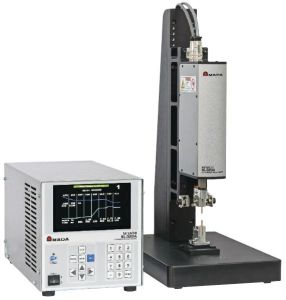
MIYACHI PECO WELD HEADS
High-tech for process and cost efficiency
A high-quality micro resistance welding relies heavily on the correct choice and control of process energy, the supply of energy to the components requiring welding and the precise weld electrode follow-up. The precise functioning of the weld head therefore has a decisive effect on the quality of the welded joint.

The application and control of force during the resistance welding process is extremely important. The mechanical system to do so is generally referred to as the weld head. The weld head (including the weld electrodes), functions to force the work pieces together and hold them during the welding. The weld head provides the current path, welding pressure or force, triggers (initiates) the welding current, provides follow-up force as the work pieces melt together, and cools the work pieces after the welding.
Development of a weld head force schedule is equally as important as development of a welding current schedule. The ideal force schedule insures that proper electrical contact resistance and proper heat balance are both achieved and maintained between the work pieces and the electrodes.
In small parts resistance welding the weld heads are of linear motion design with linear races or bearings and spring-driven force adjust­ ment. Low inertia weld heads with low mass electrode holders and low friction bearings provide fast "follow-up." "Follow-up" refers to the capacity of the weld head to accelerate and remain in contact with the work pieces as the work pieces become molten and melt together during the welding.
Recent advances in weld head design include electronic weld heads where weld head movement and force are electronically controlled, and/or electronically monitored, via a precise schedule. The precise control of an electronic weld head can program the timing of each ele­ ment of the force profile, minimize impact force, duplicate force profile between weld stations, and provide electronic evidence of the actual weld force profile. The control for electronic weld heads can be inde­ pendent of, or integrated into, resistance welding power supplies. The "Electrode Force" diagram depicts the precisely controlled force profile, including follow-up force, of an electronic weld head.

Today, force sensors, strain gauges, and motion sensors/transducers can be built into a mechanical or electronic weld head for control and/or monitoring purposes. The weld head must be designed and operated to preclude these potential problems. The most typical weld head related problems are depicted in the next drawing.
Weld Head Related Problems
Lastly, the use of properly designed fixtures to hold the work pieces in fixed position during welding is highly desirable. The work pieces must be in a fixed rigid position prior to the initiation of the resistance welding process. In manual welding, operators should be used to load workpieces in a fixture, not to hold workpieces during the welding process. Additionally, the fixtures should be constructed to insure that the welding surface of the electrodes fit squarely and completely against the work pieces.
MiyachiPeco offers a high-quality portfolio of modular weld heads to enable you to use all the different aspects of micro welding technology in a reliable, cost-effective manner.
MiyachiPeco weld heads fulfill all the conditions of the perfect weld head.
As part of the modular system developed by MiyachiPeco, the heads can be fitted with a range of special features.
The following common principles are currently available for MiyachiPeco
weld heads.
Functional Process
System based on pneumatic controlled weld head with spring follow-up system
Functional Process
System based on direct pneumatic controlled weld head
Functional Process
System based on servomotor driven weld head
MIYACHI PECO WELD PINCERS
The perfect solution for automated processes
As electronic and electric components become ever smaller, welding points are often difficult to access in automated production processes. Further there are demands for consistently high process reliability and quick electrode changing systems.
The benefits of weld pincers are particularly apparent in automated processes with high cycle frequencies and automatic systems feeding in components with inaccessible welding points.
MiyachiPeco weld pincers
Thanks to a modular system, MiyachiPeco weld pincers are suitable for all technological applications and meet a wide range of automation requirements. Just like MiyachiPeco weld heads, MiyachiPeco weld pincers are available in three different designs.
© 1997-2010 Esen Elektronik Ltd.
All rights reserved. The reproduction of all the information, articles, pictures or drawings presented in this site is subject to approval of Esen Elektronik Ltd. and/or original manufacturing companies.
ESEN ELEKTRONIK MUH. DAN. SAN. VE TIC. LTD. STI.
Yaylagul Sk. 8/4 A. Ayranci 06540 ANKARA TURKEY
Tel:+90 312 468 8114 Faks:+90 312 468 8115