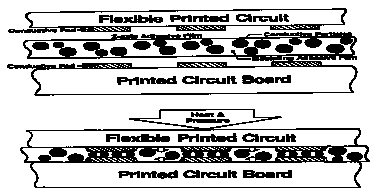
 An often-used definition for ACA is “Adhesive with conductive particles for electrical contact in Z-direction only”. Before connection, an insulating adhesive substance separates the conductive particles. When a heating element (normally called thermode) is compressing the top- and bottom parts together, the adhesive will flow, and conductive particles will be trapped, resulting in an electrical connection.
The adhesive normally consists of a mixture of thermoplastic and thermoset glues, to get the best of both properties. The conductive particles can be:
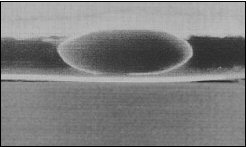
Because gold is not hygroscopic, it is sometimes preferred above graphite. Contact resistance is also lower compared to graphite particles. However, gold can be more expensive then carbon. Gold plated plastic particles are compressible, giving two big advantages. Firstly the contact resistance is lower, because a bigger surface is in contact with the upper- and lower track. Secondly the particle also works as a spring: a small relaxation of stress in the glue is compensated by an extension of the particle, resulting in an extra safe connection. Particle size is dependent on pitch; most common size is 3-10 µm. To prevent short-circuits in the XY direction, particle size must decrease if pitch is decreased. About 100 - 1000 particles per square mm are present.
The thickness of the adhesive is also dependent on the selected pitch. Thickness varies from 35 to as low as 18 µm for fine pitches. The reason for this is that fine pitches normally have lower trace heights: a trace height of 10 to 20 µm is considered ideal. When tracks are too high in relation with the pitch and the thickness of the glue, voids can occur in between the tracks. These voids can attract moisture and decrease the mechanical strength.